
It is the first highest level face-to-face meeting between the two sides after the border row escalated in eastern Ladakh in early May.
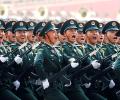
Currently, the reserve forces are under the dual leadership of military organs and local Communist Party committees and they would be brought under the control of the ruling party and the CMC from July 1, the state-run Xinhua news agency reported.
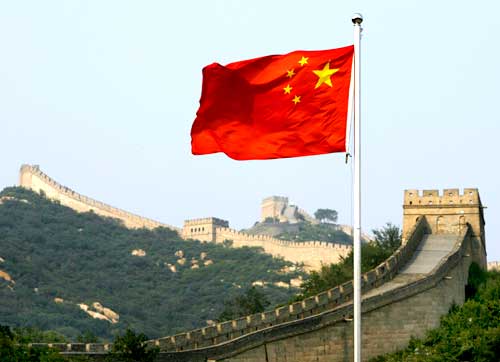
Asking the US to respect the efforts by China and India to resolve their boundary dispute peacefully, a top Chinese official on Monday said the two nations are wise enough to deal with it after the Pentagon accused Beijing of deploying more troops along the Sino-India borders.
Indian military sources said no firearms were used in the clashes and that most of the injuries were sustained following stone-pelting and use of rods by the Chinese side.
In separate statements, the Chinese foreign and the defence ministries, however, repeated Beijing's stand that India was responsible for the June 15 violent face-off in eastern Ladakh. Defence Ministry Spokesman Col Wu Qian said the two defence ministers are negotiating on the phone.
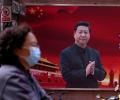
China has not limited the 'battle' to the diplomatic field alone; the People's Liberation Army has become aggressive on the ground too. The recent 'fights' in Northern Sikkim and Ladakh are part of the pattern, asserts Claude Arpi.
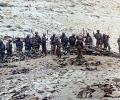
At least 38 PLA troops drowned while crossing a fast-flowing, sub-zero river in darkness, according to an article in the Australian newspaper The Klaxon which cited a report prepared by a group of social media researchers after a year-long investigation.

India is committed to further developing friendly and cooperative relations with China, says Parrikar in Beijing.
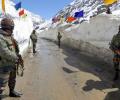
The clear assertion by New Delhi came ahead of a fresh round of Lt General-level talks between the Indian army and the Chinese PLA which government sources said is set to take place within the next two days.
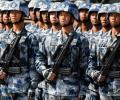
Asked about the continued tensions along the border and whether the PLA troops action was anyway related to the disagreements with the Indian government's plan to lure business out of China, Chinese Foreign Ministry spokesman Zhao Lijian said both the countries were in diplomatic contact over the face-off between their troops.

The Sheikh Hasina-Narendra Modi summit put India-Bangladesh ties on a firmer pitch. Brigadier S K Chatterji (retd) takes stock.

The aircraft carrier is China first domestically-built ship. Shandong is bigger than China's first aircraft carrier Liaoning and could house 36 fighter jets.
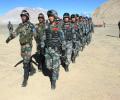
During the course of the intense and complex negotiations between senior commanders of the two armies that ended at 2 am on Wednesday, the Indian delegation also apprised the Chinese PLA about the "red lines" and conveyed that the onus was largely on China to improve the overall situation in the region, the sources said.
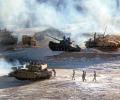
'India cannot allow Beijing's policy of stabilising and destabilising the border at will to perpetuate its own ends.' A riveting excerpt from Manish Tiwari's 10 Flashpoints; 20 Years National Security Situations That Impacted India.
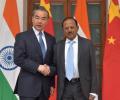
'Both sides had candid and in-depth discussions over easing the current border situation and reached positive common understandings,' it said. 'Both sides welcomed the progress achieved in the recent military and diplomatic meetings, agreed to stay in dialogue and consultation, and stressed the importance to promptly act on the consensus reached in the commander-level talks between Chinese and Indian border troops, and complete disengagement of the front-line troops as soon as possible,' it said.

'China refuses to talk to India on nuclear or ballistic missile issues and conclude any de-targeting agreement as Beijing did with Russia or a non-targeting agreement with the US.'

'India has ramped up infrastructure on its side, so the Chinese military is finding Indian soldiers in locations where they are not used to seeing an Indian footprint,' points out Harsh V Pant.
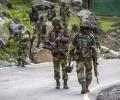
The sources said there was clear sign of withdrawal of structures and troops from the patrolling point 14 in Galwan Valley and that they are likely to move back more than a kilometre in the area.

In a major breakthrough in China's worst terrorist attack at the Kunming railway station, police on Monday captured three militants from the restive Xinjiang province who fled the scene of slashing rampage that killed 33 people and injured 143 others.
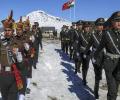
In a joint statement, the two armies said it was agreed to earnestly implement the important consensus reached by the leaders of the two countries and ensure that the frontline troops exercise restraint and avoid misunderstanding and miscalculation.
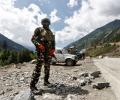
The Indian Army said the soldier, a Corporal in the Chinese People's Liberation Army(PLA), has been identified as Wang Ya Long and he will be returned to the Chinese military at the Chushul-Moldo border point after completion of formalities.

Although the pact would focus mainly on the Pacific and the South China Sea region, any action designed to deter China with or without New Delhi's active participation is a welcome move, notes Commodore Venugopal Menon (retd).
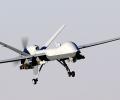
The Indian defence ministry said its border security personnel, as per standard protocol, immediately alerted their Chinese counterparts to locate the UAV and they later reverted with its location.

'The numbers of troops on both sides are enormous.' 'They are about 50,000-60,000 soldiers facing each other in that sector -- that's about the total number of troops that both sides had in the 1962 War in all sectors.'
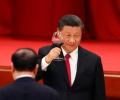
'Having tied himself in knots, he just might take a decision which is dangerous, one that could take his nation to war.'

According to official sources, the primary objective of Wei's visit is to deliberate with Indian defence establishment on implementation of decisions taken by Modi and Xi in their informal summit in Wuhan in April.
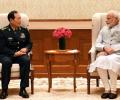
'China's military is expected to deploy full throttle its new equipment including J-20 stealth fighters, drones, medium range missile systems, surveillance and others to continue to put psychological pressure on India,' warns Srikanth Kondapalli, Professor in Chinese Studies, JNU.

'The military advantage the Indian Army had gained by the Special Frontier Force occupying the heights of the Rezang La-Rechin La ridge on the Kailash Range is lost without the PLA withdrawing to east of the Khurnak Fort line.'
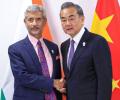
The joint statement said Jaishankar and Wang agreed that both sides should take guidance from the series of consensus reached between leaders of the two countries on developing India-China relations, including not allowing differences to become disputes.
The MEA said it was the Chinese side that recently undertakook activities hindering India's normal patrols in the areas.

The MEA spokesperson further said the actions and behaviour of the Chinese side since earlier this year along the LAC have been in "clear violation" of the bilateral agreements and protocols concluded between the two countries to ensure peace and tranquility on the border.
In fact, given the current tensions and massed troops on both sides, there is a danger that the LAC will become more like the Line of Control with Pakistan, a heavily fortified and strongly defended border where weapon fire exchanges regularly occur. Indeed, Stratfor Worldview research has listed a sharp increase in new Chinese facilities along the LAC in 2019-20.
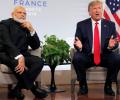
Trump on Wednesday said in a tweet that he was "ready, willing and able to mediate" between the two countries.

Indian Army officers are convinced China is maintaining the pretence of dialogue and negotiations in order to create the opportunity to occupy more Indian territory. Senior Indian planners apprehend this might be a Chinese ploy to divert attention from Depsang, in Northern Ladakh, which might be China's actual target.
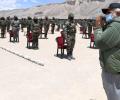
'By not even acknowledging China's occupation of Indian territory Modi signalled to Beijing that he was not prepared to used forceful means to vacate the Chinese occupation, and that his government was reconciled to this loss of territory and accepted the fait accompli engineered by the PLA.'

The Ministry of External Affairs (MEA) spokesperson Anurag Srivastava said complete disengagement requires re-deployment of troops by each side towards their regular posts on their respective sides of the Line of Actual Control(LAC) and this can be done only through mutually agreed actions.
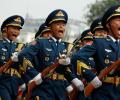
Since the June 15 clash, the PLA has inducted large numbers of troops, armoured vehicles and artillery along the LAC, from Depsang and Galwan in northern Ladakh to Hot Springs, Pangong Tso, and Chushul in central Ladakh, to Demchok and Chumar in southern Ladakh.
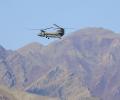
For both India and China, the most likely option -- and the most challenging -- appears to be a freezing of the status quo.
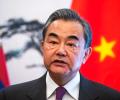
Was Wang Yi'S visit intended to remind India of 1962, asks Claude Arpi?

The coming together of the Quad and the Australia-UK-US grouping would be a formidable adversary, moving toward the creation of a 'thousand ship navy' that reins in the PLA navy in the Indo-Pacific.
 © 2026 Rediff.com - Advertise with us - Disclaimer - Privacy Policy - Sitemap - Feedback - About us - Terms of use - Grievances